Chapter 02 : Vocabulary Development
| Introduction Developing vocabulary from both conversations and written texts is pivotal as it helps you accumulate words and shape your ability to communicate effectively. Knowledge of wide-ranging vocabulary enhances your ability to comprehend complex concepts, express yourself clearly and excel academically across disciplines. In this chapter, you will share your stories using given words, act out dialogues, play a Pelmanism vocabulary game, deliver a speech and form new words from it. You will also read a story and act out a courtroom drama. The competencies developed will enable you to use English more confidently and successfully. |
| Think about
|
Activity 2.1
Writing unfamiliar and complex vocabulary from oral texts
(a) Study the following pictures and orally describe what the children are doing.
|
|
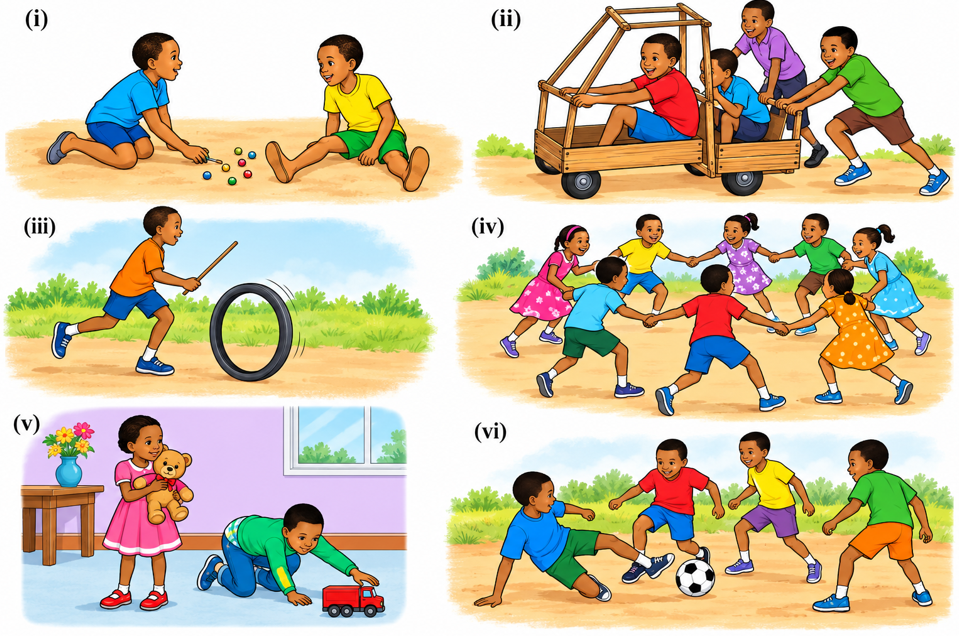
1. Choose five keywords from your description in Activity 2.1 (a) and list other words that have the same meaning as the five chosen words.
2. Read any English newspaper and identify new words. Share the words with your partner to discuss their meanings and construct example sentences containing those words.
3. Listen to a recorded speech by a well-known political figure who is a native speaker of British English and learn all the new vocabulary used in that speech. Write the meanings of those words and use them to construct example sentences.
4. Take note of the target audience for the speech in 3 above and rework the speech with specific vocabulary for a different audience.
(b) Act out the following dialogue between Tiba and Sikitu and complete the activities that follow.
[Tiba and Sikitu are Form Five students who aspire to become environmentalists. They normally meet every Friday for the Mazingira Bora Club. While waiting for other members, they start up a conversation.]
Tiba: Hi Sikitu!
Sikitu: Hello Tiba! It's nice to see you.
Tiba: Same here. I've been thinking more about environmental problems issues lately. What are your thoughts on the escalating environmental problems we face?
Sikitu: Tiba, it's a complicated scenario. One major concern is the anthropogenic impact on biodiversity. The loss of diverse ecosystems due to deforestation and pollution is alarming.
Tiba: I read about the ozone layer depletion in our science class. It's disconcerting. How does it contribute to environmental issues?
Sikitu: Excellent question, Tiba. Ozone layer depletion leads to an increase in ultraviolet radiation from the sun reaching the Earth's surface, and so causing adverse effects on human health and the ecosystems. It's a pivotal aspect of our environmental challenges.
Tiba: Speaking of ecosystems, what about the concept of ecological overshoot? How does it relate to our current environmental crisis?
Sikitu: Spot on, Tiba! Ecological overshoot occurs when human demand exceeds the Earth's capacity to regenerate resources. It's like withdrawing more from our environmental bank account than we can deposit in it. That jeopardises the planet's sustainability.
Tiba: So, what can we do to address these issues?
Sikitu:Mitigation strategies include adopting sustainable practices, reducing our ecological footprint, and supporting conservation efforts. Individuals and societies must be environmentally conscious and environmentally proactive.
Tiba: These are pressing concerns. I wonder how our generation can influence policymakers to prioritize environment protection.
Sikitu: An astute observation, Tiba. Critical thinking and effective communication skills are essential. By advocating for sustainable policies, participating in environmental initiatives, and engaging in informed discussions, we can influence positive change.
Tiba: True. And what about fostering creativity? How can we inspire innovative solutions to tackle environmental issues?
Sikitu: Great question, Tiba! Encouraging creativity involves thinking beyond traditional approaches. We can explore green technologies, sustainable design, and inventive ways to reduce waste. Creativity is a powerful tool to devise novel solutions.
1. Use the phrases in bold to start a new conversation. You may use the following conversation prompts to ask a fellow student or anybody else; "What images spring to mind when you hear the word '.......'?" "What is the best way to learn this word as a vocabulary item?"
2. Use environment-specific vocabulary to suggest a unique solution to a particular environmental issue in your community. Use as much environment-specific vocabulary as possible to detail your suggestions.
3. Expand the following conversation between James and Naomi about the environment using the vocabulary provided below.
| pollution, waste, bag, global warming, herbicide, ivory, box, environment, elephant, gun, tree, stump, axe, book, paper, bin, windfarms, power, refrigerator, tusk, recycling |
James: What environmental issue are you concerned about?
Naomi: ____________________________
James: Why?
Naomi: ____________________________
James: And what can we do about it?
(c) Play the Pelmanism vocabulary game using the provided procedure and words in the box below. You will need to find the definitions of the words first.
| Conundrum altruistic resilient eloquent inherentambiguous ubiquitous pragmatic benevolent divergent |
1. Gather a set of index cards or small pieces of paper. Write each word on a card and its definition on another card.
2. Shuffle the cards thoroughly to mix up the words and their definitions. Then, lay them face down on a flat surface, such as a table or the floor.
3. To play, ask each player to flip over one card of a word at a time and search for the match with its definition. If they find a match, they go again. If the cards are not a match, the player turns them back and the next player goes.
4. The player who correctly picks many matches of words and their definitions becomes the winner.
5. Most often, the game is played by two to four people at a time.
(d) Read the following speech by H.E. Dr Samia Suluhu Hassan and observe how words are used in writing speeches.
Statement by H. E. Dr. Samia Suluhu Hassan, President of the United Republic of Tanzania to the United Nations at the General Debate of the Seventy-Sixth Session of the United Nations General Assembly, New York - 23rd September 2021
Your Excellency Abdulla Shahid, President of the General Assembly;
Your Excellency António Guterres, Secretary General of the United Nations; Excellencies Heads of State and Government;
Distinguished Delegates,
Ladies and Gentlemen.
Let me commence by joining the previous speakers in applauding you, Mr President, for being elected to preside over the 76th Session of this August Assembly and for the exemplary manner in which you have been presiding over this Session. I also commend you for how you mastered making it possible for us to meet physically despite unprecedented circumstances brought on by the COVID-19 pandemic.
The holding of a physical general debate this year, albeit with some limitations, demonstrates again that humanity and multilateralism cannot and should not succumb to the virus. And thus where there is a will, there is always a way.
This spirit is what we need going forward. It is why I support and subscribe to the theme of this 76th session that calls all of us to "build resilience through hope to recover from COVID-19, rebuild sustainability, respond to the needs of the planet, respect the lives of people, and revitalize the United Nations".
Mr President,
As this is my maiden speech at the United Nations General Assembly, allow me on behalf of the people and the Government of the United Republic of Tanzania to thank all members of the United Nations for your condolence messages extended to our nation following the untimely passing of our late President, Dr John Pombe Joseph Magufuli, on 17th March 2021. May his soul continue to rest in eternal peace.
We remain indebted to you for the thoughtful and comforting messages that helped us prevail over that unprecedented test to our nationhood. It is in the same vein that I thank the outgoing President of the 75th Session for dedicating a slot on the 59th Plenary meeting of the General Assembly, on the 16th of April 2021 to pay tribute to our beloved late President Dr Magufuli. Indeed, this was a gesture of solidarity and brotherhood.
Mr President,
It is not by sheer coincidence that I chose to attend the United Nations General Assembly as my first trip outside Africa since I took office. I did so, out of my deep sense of conviction and faith in multilateralism in solving a multitude of challenges that our world faces today.
I am here to assure you that, under my stewardship, Tanzania will remain a formidable member of the United Nations and a dependable supporter of multilateralism. We will keep our arms open to those who embrace us and engage with us. We will continue to be the Tanzania that you have known and relied on. A Tanzania that peacefully and respectfully co-existed and cooperated with all countries, big or small, mighty or weak, rich or poor, to make this world, our world, a better place for all of us.
Mr President,
The COVID-19 pandemic has reminded us how vulnerable we are as individual countries, regardless of our size, wealth or geography. As we meet here today, we have less than a decade ahead to meet our collective commitment to achieve the Sustainable Development Goals (SDGs). I note with great regret that, according to Sustainable Development Goals report 2020, right now, the world is not on track to achieve the 2030 Agenda mainly due to the adverse impact of COVID-19.
The report further shows that, in some areas, this pandemic has even reversed the progress that was already achieved years back. For instance, it is expected that around 71 million people who got out of extreme poverty will be pushed back into that situation because of this pandemic. What is depressing is that these impacts are not felt evenly. We, in the developing world, are the most affected. It is, therefore, imperative that concerted efforts be undertaken to address this devastating situation.
Mr President,
Developing nations must be assisted in addressing the socio-economic impact of COVID-19. On this note, we are thankful to multilateral financial institutions like the International Monetary Fund (IMF) for their efforts in saving many economies from collapsing. Nevertheless, intervention are important. We cannot afford to take refuge on the onset of COVID-19 as an excuse for not making sufficient progress in achieving the Sustainable Development Goals.
Mr President,
Tanzania has not been spared by COVID-19. After the onset of the pandemic, we, in Tanzania and I believe in many other developing countries, were stuck in the twilight of protecting lives and protecting livelihoods. The measures advocated by the World Health Organisation (WHO) were geared towards protecting lives. However, in an economy like Tanzania's, where a large proportion of people live on a subsistence economy,whom we need to keep them afloat, my country, therefore, adopted all the necessary measures to curb the spread of COVID-19, including joining the COVAX facility, to ensure that Tanzanians gain access to the COVID-19 vaccine. The vaccination campaign started in July this year with the most vulnerable communities and later on other age groups.
Mr President,
Globally, when COVID-19 vaccines were being developed, some of us were hopeful that this would mean something good to all of humanity. Nevertheless, we have come to learn that the virus is moving faster than the global production and distribution of vaccines, as the vast majority of vaccines have been administered in high and upper-middle-income countries. With the current pace, it is less likely that we will meet the WHO's threshold of vaccinating at least 40 percent of people in every country by the end of 2021, and at least 70 percent by the first half of 2022.
The level of vaccine inequity that we see is appalling. It is truly disheartening to see that whilst most of our countries have inoculated less than 2% of our populace and thus, seek more vaccines for our people, other countries are about to roll out the third dose, calling it "booster vaccine". We tend to forget that nobody is safe until everyone is safe. It is indispensable that countries with surplus COVID-19 vaccine doses share them with other countries. On another note, it is our humble request that patent rights on COVID-19 vaccines should be waived for developing countries so that they can afford to produce the vaccine. This is not only a necessary move to end this pandemic but also the right thing to do to save humanity.
Mr President,
On economic fronts, the United Republic of Tanzania, like other countries, has not been spared by the effects of COVID-19. Before the pandemic, our economy was growing at a steady rate of 6.9 percent compared to the current growth rate estimated at 5.4 percent. We are now embarking on reviving the tourism sector which was badly affected because of travel restrictions put in many countries as a means to curb the spread of COVID-19.
While slowly trying to revive most of the economic activities suffocated by the pandemic, the government continues to work hard to improve the business environment and attract more investment. Aware of the nexus between economic growth and governance, we managed to maintain peace and political stability, with a vibrant democracy and institutionalised good governance practices, upholding the rule of law and human rights.
Mr President,
I wish to take note of the Secretary General's Report on "Our Common Agenda" which raises key issues of our common concern such as gender equality, climate change, and youth development.
As the first female President in the history of my country, the burden of expectation to deliver gender equality is heavier on my shoulders.
It is for this reason that I commend the initiative by the UN-Women, France and Mexico to organise the Generation Equality Forum that took place in Paris in June this year, whereby my country volunteered to champion Women's Economic Rights and Justice. Aware that being passionate about gender equality is not sufficient, my government is reviewing policy and legal frameworks to come up with actionable and measurable plans to ensure the economic empowerment of women but also other aspects of gender equality and gender parity.
We are also working on designing the implementation of gender-responsive macro-economic plans, budget reforms and stimulus packages to reduce the adverse impact of COVID-19 and girls living in poverty.
Mr President,
The challenges of climate change are affecting livelihoods, peace and security and food supplies and our people. The Tanzania government spends 2 to 3 percent of GDP to mitigate and build resilience of communities, and this is not in a country that is still grappling with poverty coupled with the emergence of the COVID-19 pandemic. The pandemic has compromised our capacity to respond to the harmful impact of climate change. Therefore, our actions today determine the future of our planet in terms of climate change. In this regard, I call for a transparent modality for financial disbursement and emphasise that developed countries should fulfil their commitment to contribute USD 100 billion annually by 2025 to facilitate the implementation of the Paris Agreement.
Mr President,
In concluding my remarks, I wish to echo my country's commitment to pursuing the principles of multilateralism as enshrined in the Charter of the United Nations. I urge other nations to continue supporting this august institution. The onset of COVID-19 has given us a lesson that we are deeply intertwined and that unilateralism will not win us anywhere unless it comes to challenges that transcend our national borders.
A wise person once said, and I quote, "Alone, one will go fast, but together we will go far". Multilateralism must always prevail!
I thank you all for your kind attention!
Adapted from: (https://statements.unmeetings.org/media2/180.0610/2021/0923/MBCAf0rG7uL70WgYUQ4gR.pdf) Revised 2nd March 2024.
- Write the meaning of each of the words/phrases in bold in the above speech by H. E. Dr. Samia Suluhu Hassan.
- What similar words/phrases can be used to replace each of the words/phrases in bold without altering the original meaning of the speech?
- For each of the following words extracted from the President's speech in Activity 2.1 (d), construct one sentence containing it.
| succumb transcend mitigate dishearten afloat devastate confidence |
(e) Write the synonym of each word in the following table. Then, for each synonym that you have written, construct two sentences containing it.
| S/n | Word | Synonym |
| 1. | commence | |
| 2. | subscribe | |
| 3. | recover | |
| 4. | extend | |
| 5. | comfort | |
| 6. | assure | |
| 7. | engage | |
| 8. | remind | |
| 9. | adverse | |
| 10. | administer | |
| 11. | save | |
| 12. | revive | |
| 13. | contribute |
(f) Imagine you have been chosen to deliver a speech on Youth Day. Select a topic from the following: on the child's rights, environmental conservation, gender violence, responsible tax-payer , or corruption, and do the following activities.
(f) Imagine you have been chosen to deliver a speech on Youth Day. Select a topic from the following: on the child's rights, environmental conservation, gender violence, responsible tax-payer , or corruption, and do the following activities.
- Prepare a speech that you will deliver on Youth Day.
- Rehearse your speech and deliver it to the class to show that you are a skilled orator.
- Ask your audience to write down any new vocabulary they hear from your oration and lead a discussion about the words.
www.learninghubtz.co.tz
Activity 2.2
Discovering the meanings of vocabulary using context, technical dictionary, thesaurus, and encyclopedia
(a) Read the following story and complete the activities that follow.
Cyberbullying
Before I tell you my story, let me introduce myself. My name is Ngapona, which literally means: ‘not yet healed.’ My paternal aunt gave me this name because she felt it suited me for my mother had lost a child before I was born. I have been told that people believed I would die because I was so skinny and weak at birth. This name has been a thorn in my life as I have been facing many challenges. However, this is a story for another day.
One fateful day, I woke up with a heavy feeling in my heart. I could not tell what was wrong with me. I took a long time to prepare myself for school. As a result, I arrived at school later than usual. Fortunately, nobody stopped me at the school gate. That was unusual since the teacher on duty would always be at the gate. I dragged my feet towards the classroom, which was at the far end of our school. A level students’ classrooms were separated from the other buildings. I could hear my classmates speaking. When I entered the classroom, there was deafening hush; one could hear a pin drop. The teacher said, “Ndele and Deeja came up and hugged me, tears rolling down their cheeks. “Did you guys miss me this much?” I joked smilingly. Ndele could not hold it any longer; she sobbed uncontrollably. Deeja wiped her tears away with the back of her hand and looked at me in silence. “What’s wrong?” I asked, looking at them in a perplexed manner. “Mtuolowe is no more,” Deeja managed to say. “What? How? When? Who?” I exclaimed. “She is dead, Ngapo,” explained Ndele.
A cold shiver ran down my spine. My head started spinning like I had received a heavy blow at the back. Mtuolowe and I had been as thick as thieves since primary school. I looked at everybody’s sombre face. I could not hold it any longer. Here, I let out the most piercing cry ever; the whole class joined in. We mourned our friend, a classmate who had gone too soon. From a distance, teachers could hear our cries. They rushed into our classroom. Our confused, class teacher, and three others, whom I cannot remember. After ten minutes, we had all stopped crying, but one could hear some sniffling. “Would someone … anyone … tell me what has exactly happened?” I inquired. “Ngapo, Mtuolowe committed suicide because of cyberbullying. She left a note,” Ndele said.
“What is cyberbullying?” Asked Deeja.
“Cyberbullying is sending, posting or sharing negative, harmful, false or mean content about someone else via SMS or social media. It also includes sharing personal or private information about someone to embarrass or humiliate them. In our friend’s case, someone video-recorded her in the school uniform in a compromising situation with someone and posted it online. Mubitole was also a victim of doxing, where someone had maliciously exposed her private information, such as her home address and phone number, online. This was just the beginning of a series of cybercrimes against her. It made the rounds and ultimately reached her parents. Upon seeing the video and knowing that the behaviour is unacceptable in our society, her mother refused a massive stroke. She was thus rushed to the hospital. Out of sheer panic, one family member severely beat up Mubitole without listening to her side of the story first. The rest is history." Nela said.
“It seemed it became worse because a group of trolls had been orchestrating a flame war against Mubitole using fake accounts to spread rumours. To make matters worse, they had also been catfishing unsuspecting students, manipulating them into divulging sensitive information about her.” Another student added.
It was said that Mubitole pleaded with the perpetrators to stop what they were doing. However, they continued with their campaign of harassment and even disrupted the school's online platforms. Feeling frustrated and helpless, Mubitole gave up.
“What a tragedy! We would be better off without social media, frankly speaking.” One student remarked. “I agree! Social media are detrimental to our generation. Let’s consider our relationship with online friends. Do our friends care about our lives?” Asked another student.
Our class teacher, Ms. Lupakyo, who had been silent all this time said, “I feel that social media have made people lose their ability and interest in face-to-face interaction. This has led us to grow up learning to communicate with others by looking at the screen, not in another person’s face. We are missing out on the interaction that made many generations before us more mature and sensitive.” “You’re right, My sister always chats with lots of friends on Twitter and Facebook. However, I’ve never seen them together and she acknowledged that they have never met. They end up chatting only on social media. In my opinion, this is not appropriate.” Ndele added.
“I beg to differ with you. Your sister doesn’t have face-to-face interaction with the majority of her friends because she is pressed for time. You need to know that scheduling in-person meetings can be too challenging, especially if you live far apart. Besides, if everyone has a tight schedule, it might be difficult to schedule in-person interaction. As a result, they opt to interact via social media,” said Pyana.
I looked around and most of my fellow students nodded their heads. I cleared my throat to get their attention. “Guys, I know you are sad, but it is not all doom and gloom with social media. I see your point, but through social media, my connection and interaction have particularly been broadened. I’ve learnt to appreciate different perspectives and increase my knowledge of various things. Through social media, I share many ideas with various people.” Some of the students agreed with me.
“I agree. To tell you the truth, I was very shy to look someone in the eye, but social media helped me communicate with them while hiding behind my screen. Besides, I interact with people beyond borders. I connect with others who share my ideas and interests,” Tuma said.
“I hear you, but how do we prevent another tragedy from happening?” Tuma who had been silent until this time said.
“We need to put an end to the cyber chaos by raising awareness about the dangers of cyber manipulation and the importance of safeguarding their digital footprint. Together, we can organise workshops on online safety and privacy learning how to recognise and report cybercrimes. The school should also implement strict protocols to prevent cybercrimes and provide support services for students affected by online shaming and cyberbullying. This will empower us to reclaim our digital space and protect ourselves from harm” I said.
After a long discussion, we concluded that social media has its pros and cons. If used properly, they can serve as social, economic, educational, and political platforms. On the other hand, if used inappropriately, they may cause tragedies like the death of our friend. As the dust settled, I reflected on the valuable lessons I had learned throughout the ordeal. I realised that while the digital world offered endless opportunities for connection and learning, it also harboured hidden dangers. By staying vigilant and proactive, I could help create a safer online environment for myself and my peers, one where everyone’s digital footprint is respected and protected. Mubadala was a good friend. I wish she had spoken with me what she was going through. Maybe, we would have saved her. She is gone, but I will always remember her. I am not yet healed; her death has had a devastating impact on my life.
Adapted from Fetish for Advanced Level Form 6 (2023)
1. Write the meaning of each of the words/phrases in bold in the story.
2. What similar words/phrases can be used to replace each of the words/phrases in bold without altering the original meaning of the story?
3. Construct one sentence for each of the following words extracted from the above story.
| Deafening perplexed sombre doxing divulging cyber |
4.Identify all cyber-related terms in the text.
5.Drawing on the story, explain how you can deal with social media ethically and responsibly.
(b) Use the context, technical dictionary, thesaurus, or encyclopedia to find the synonyms for the italicised words in the following excerpt of cyberbullying story.
One joyful day, I woke up with a heavy feeling in my heart. I could not tell what was wrong with me. I took a long time to prepare myself. As a result, I arrived at school later than usual. Fortunately, nobody stopped me at the gate. That was unusual since the teacher on duty would always be at the gate. I dragged my feet towards the classroom, which was at the far end of our school. A-level students’ classrooms were separated from the other buildings. I could overhear my classmates speaking. When I entered the classroom, there was a deafening hush; one could hear a pin drop. Two of my classmates, Ndele and Dondai, came up and hugged me, tears rolling down their cheeks.
(c) Rewrite the passage in Activity 2.2 (b) by replacing the italicised words with their antonyms. You may need to change some of the words, phrases, and sentences to maintain logic and flow.
Activity 2.3 Forming new words through word-formation processes
(a) Complete the following sentences by filling in the gaps with the words in brackets after applying the appropriate word formation process.
1. How long is the ____________ from Dar to Mwanza? (FLY)
2. We offer free ____________ for purchases over 100 000 shillings. (DELIVER)
3. My best friend has a great ____________. (PERSON)
4. You need a lot of ____________ to write a good story. (IMAGINE)
5. I have to hold a ____________ at my brother’s wedding. (SPEAK)
6. I have no ____________ in finding the right shoes. (DIFFICULT)
7. ____________, I was invited to watch the new film. (LUCKY)
8. My mother spent her ____________ in Musoma. (CHILD)
9. The party turned out to be a huge ____________. (DISAPPOINT)
10. The county is facing a population ____________. (EXPLODE)
Role-play the drama about the Case of Mr Tuli vs Mr Ngaf and complete the tasks after it.
The trial is being presided over by the Honourable Judge Madugi in front of a packed room. Attorneys for the prosecution and defense lawyers are ready to present their cases. Mr Ngaf, the accused, is seated intently as Tuli, the accuser, observes intently from the plaintiff’s bench.
Prosecutor: Your Honour, esteemed members of the jury, the case being considered before you today is one of egregious land theft. Mr Ngafu, the defendant, is accused of unlawfully obtaining land rightfully owned by the plaintiff, Mr Tulli. We will establish beyond a reasonable doubt that Mr Ngafu committed fraud and trespassed Mr Tulli’s property with knowledge.
Defence Attorney: Your honour, I object! The prosecution is accusing my client without evidence.
Judge: Sustained. Prosecutor, please continue presenting your evidence.
Prosecutor: Your honour, thank you. Mr Tulli, please take the stand.
[Mr Tulli takes the stand, swearing to speak the truth.]
Mr Tulli, can you describe the events leading up to the alleged land theft by Mr Ngafu?
Mr Tulli: Certainly. I own the land in question and I have legal documents to prove it, having bought it over a decade ago. But Mr Ngafu started building structures on my land and claimed it as his own without any legal right or permission.
Prosecutor: And did you confront Mr Ngafu about this trespass?
Mr Tulli: Yes, I did indeed. I demanded he stop what he was doing and leave the area right away. But he refused, pointing to forged documents purportedly proving his ownership.
Defence Attorney: Your honour, objection! The witness is making speculative statements regarding the documents without proper authentication.
Judge: Overruled. The witness has the right to recount his experiences.
Prosecutor: Mr Tulli, did you file a lawsuit against Mr Ngafu?
Mr Tulli: Yes, I did file a complaint with the local authorities and hired a lawyer to represent me in court.
Prosecutor: Thank you, Mr Tulli. No more inquiries.
Defence Attorney: Your Honour, I request the opportunity to cross-examine the witness.
Judge: You may proceed.
Defence Attorney: Mr Tulli, isn’t it true that you failed to sufficiently fence or demarcate your property, leaving it open to encroachment?
Mr Tulli: No, that is not true. I have preserved proper boundaries, as outlined in my land title deed.
Defence Attorney: Yet, there are no physical barriers to prevent unauthorized access, are there?
Mr Tulli: While there may not be physical barriers, the legal boundaries are clearly defined.
Defence Attorney: Thank you, Mr Tulli. No further questions.
[The defence calls Mr Ngafu to the stand.]
Mr Ngafu, can you explain your side of the story regarding the land in question?
Mr Ngafu: Certainly. I acquired the land through a leal transaction with a third party who claimed to be the legitimate owner. I did not know any prior ownership by Mr Tulli.
Defence Attorney: Were you aware that you were on Mr Tulli’s land?
Mr Ngafu: No, I thought I was acting within the bounds of the law based on the information provided to me.
Defence Attorney: And did you falsify any documents to support your claim of ownership?
Mr Ngafu: No, I trusted that the documents that the seller provided to me were authentic.
Defence Attorney: Thank you, Mr Ngafu. No further inquiries.
[After both sides present their cases and closing arguments, the jury deliberates. They return with a verdict of guilty against Mr Ngafu.]
Judge: Mr Ngafu, you have been found guilty of illegally obtaining the land legally owned by Mr Tulli. The court hereby sentences you to restitution of the land to Mr Tulli and pay him a fine for damages you have caused. You are also ordered to complete community service as penance for your bad deeds
[The courtroom erupts into murmurs as the trial concludes, bringing a sense of closure to the long-standing dispute between Tulli and Ngafu.]
1. Using the context, technical dictionary, thesaurus or encyclopedia find the synonyms of the words in bold print.
2. Construct ten sentences using any ten synonyms from (1).
(c) Create a court case of your interest. Then act it out in class, with one person playing the judge, another the accused, a third person the accuser and two more people as lawyers. When writing the script for the court proceedings, show your competency in word formation processes (such as conversion, compounding, coinage and borrowing.)
(d) Complete the following worksheets by filling in the gaps in each sentence with an appropriate form of the word in brackets.
Worksheet 1
1. The __________ of the novel is set in $19^{th}$ -century England. (begin)
2. She __________ her grandmother’s old recipes to create her unique dishes. (use)
3. The athlete’s __________ dedication to training paid off when he won the championship. (relent)
4. The __________ of the crime scene was collected and analysed by forensic experts. (evidence)
5. The __________ to the company’s success lies in its innovative products and dedicated employees. (key)
6. The __________ of the new building was completed ahead of schedule. (construct)
7. The __________ of the storm forced residents to evacuate their homes. (intense)
8. The __________ of the river provided a picturesque backdrop for the wedding ceremony. (flow)
9. The __________ of the project required careful planning and coordination. (success)
10. She __________ her hand to signal the start of the race. (wave)
Worksheet 2
1. The __________ cat climbed up the tall tree to catch the bird. (agility)
2. We had a __________ dinner party last night with delicious food and lively conversation. (delight)
3. Despite his __________ appearance, he had a warm and friendly personality. (scare)
4. A __________ building stood out among the other skyscrapers in the city. (majesty)
5. The __________ river flowed gently through the lush green valley. (meander)
6. She wore a __________ dress to the formal event, looking elegant and sophisticated. (glamour)
7. The __________ athlete trained hard every day to prepare for the upcoming competition. (dedicate)
8. Their __________ house was filled with laughter and joy during the holiday season. (beauty)
9. He had a __________ personality, always making others laugh with his witty jokes. (humour)
10. The __________ road stretched for miles through the picturesque countryside. (wind)
(e) Choose a topic of your interest related to your field of study or current events. Then, explore it in detail using the following guidelines.
1. Use encyclopedia, online resources, and other reference materials to learn more about your topic.
2. Compile a list of key vocabulary words related to your topic and find their synonyms using technical dictionaries and thesauruses.
3. Prepare a presentation or report on your topic by using topic-specific vocabulary to convey meaning.
4. Present your findings to the class
www.learninghubtz.co.tz

Hub App
 For Call,Sms&WhatsApp: 255769929722 / 255754805256

For Call,Sms&WhatsApp: 255769929722 / 255754805256 WHATSAPP US NOW FOR ANY QUERY
 MATOKEO YA KIDATO CHA VI 2026
SECONDARY REGIONAL EXAMS
PRIMARY REGIONAL EXAMS
FORM VI NECTA REVIEWS
FORM IV NECTA REVIEWS
FORM II NECTA REVIEWS
STD VII NECTA REVIEWS
STD IV NECTA REVIEWS
SECONDARY EXAMS SERIES
PRIMARY EXAMS SERIES
PRIMARY SUBJECT NOTES
SECONDARY SUBJECT NOTES
SECONDARY TOPICAL EXAMS
SECONDARY TOPICAL QUESTIONS
PRIMARY TOPICAL QUESTIONS
PRACTICAL EXAMS & NOTES
SECONDARY REGIONAL EXAMS
DOWNLOAD SUBJECT NOTES
SCHEMES OF WORK (PRIMARY & SECONDARY)
LESSON PLAN
SECONDARY LOG BOOKS
PRIMARY LOG BOOKS
LITERARY WORKS / UCHAMBUZI VITABU
METHALI ZOTE ZA KISWAHILI
Vitendawili Vya Kiswahili
FORM VI RESULTS 2024
FORM FIVE SELECTION 2024
Matokeo KIDATO CHA II 2024
Matokeo Darasa IV 2024
MATOKEO KIDATO CHA IV 2023
FORM ONE SELECTION 2024
FORM VI RESULTS 2023
Matokeo Darasa IV 2022
App Ya Learning Hub Tanzania